Circuit Dreams utilises a d20-based system, with modifiers influenced predominantly by stats, skills, and cyberware - although these modifiers may take more of a backseat in certain rolls, such as Aim Rolls.
Generally speaking, a roll of 10 or above is considered a success. This threshold may be raised or altered at DM discretion, or under specific circumstances - the base DC is 10, but may be raised by a target's Reflexes stat.
Attacking is divided into two rolls: an Aim Roll, followed by a Damage Roll. A pistol for example may fire with a 1d20+2, but its damage roll may only be a 1d4+1. Weapon stats are not currently finalised. Additionally, if after playtesting and review we find that two-roll segmentation is not preferred, we may swap to Static Damage for weapons.
Each character has five attributes: Body, Intelligence, Reflexes, Technical Ability, and Willpower. Points are invested primarily at Character Creation, though Cybernetics can improve them later.
Each attribute has a maximum score of 10 (counting initial investment, background traits, and cyberware upgrades combined). The Attribute Modifier is your score divided by two, rounded down - so a score of 7 gives a +3 modifier.
Each attribute governs three Skills. Your Skill Score is derived from your Attribute Score, any Cyberware or Skill-Shards, and your Skill Proficiency bonus. Proficiency adds +3 to any check made with that skill, but can only be held in a skill whose parent attribute has at least 1 point invested - unless granted by a Skill Shard.
| Score | Modifier | Score | Modifier |
|---|---|---|---|
| 1 | +0 | 6 | +3 |
| 2 | +1 | 7 | +3 |
| 3 | +1 | 8 | +4 |
| 4 | +2 | 9 | +4 |
| 5 | +2 | 10 | +5 |
An Origin is a backstory kick-off point for character creation. It shapes some key elements of your character, and helps provide inspiration for ideation. Origins can also grant Exclusive Features - design aspects that are unique to that origin. Exclusive Features are currently not yet defined, and will be populated in a future compendium revision.
Origins are not tied to Starter Traits, allowing for more freedom in character design. There are however some origins that are exclusive depending on your character's race: Human Origins are only available to Humans, and AI Origins only to AIs. Mutual Origins are open to both without restriction.
A Starter Trait is a small mechanical bonus applied at character creation, representing the specific area where a character's skills were sharpened before play begins. They are analogous to the skill bonuses granted by Backgrounds in D&D 5e - not powerful abilities, but meaningful boosts that reflect lived experience.
Starter Traits are separate from Origins. An Origin describes your character's backstory and social identity; a Starter Trait describes where their competence was built. The two do not need to match - a Street Rat origin with a Techie trait is perfectly valid - though they may coincide at the player's discretion. This separation allows characters to draw from a broader range of backgrounds and influences.
Starter Traits function primarily as partial stat boosts. Each trait adds points to one or more attributes at character creation, subject to the following restrictions:
Minimum investment required. You must already have at least 1 point invested in an attribute before a Starter Trait can raise it. A trait cannot bring a stat from 0 to 1 or 2.
Trait cap of 8. A Starter Trait cannot raise an attribute above a score of 8. You cannot use a trait to raise a stat from 8 to 10, or from 7 to 9. The maximum is 6→8 or 7→8.
Overflow converts to proficiency. If a Starter Trait would raise an attribute above 8, the overflow does not apply as a stat bonus. Instead, the character gains one additional Skill Proficiency in any skill from that attribute's subset. For example: if you take the Techie trait with a Technical Ability score of 7, you may choose one additional proficiency from Engineering, First Aid, or Piloting.
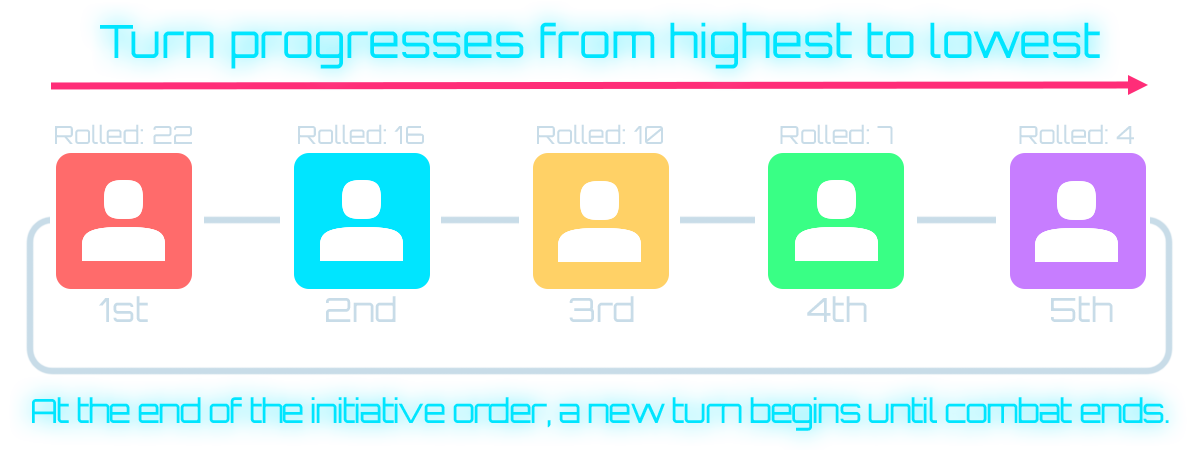
When entering combat, all players involved must roll Initiative to determine the order in which they act. Each player makes a Reflexes roll (1d20 + Reflexes modifier), and the turn order proceeds from highest to lowest result.
If two combatants tie, the character with the higher Reflexes attribute score goes first. If both have the same score, they re-roll against each other to break the tie.
Any additions to the turn order mid-combat - whether players, allies, or enemies - are always placed at the very end of the current turn order.
NPCs, both friendly and hostile, are handled at DM's discretion. They may roll for initiative normally, be placed at the front of the turn order, or be added to the end.
To roll for initiative in-game, use /roll reflex.
Action Economy is still being developed and will be expanded in a future revision. The actions listed below represent the current known set, but costs, interactions, and edge cases are subject to change.
On your turn, you may take two Actions and one Reaction. All actions must be declared before they are resolved. When taking a Reaction, that must also be declared.
A Reaction can be taken at any point during a round - including on another character's turn - so long as you have not already used your Reaction in the current turn order. Once your Reaction is spent, it is not refreshed until the start of your next turn. For example, if you use your Reaction to make an opportunity attack against a passing enemy, you cannot use that Reaction again until your next turn begins, even if another opportunity arises in the same round.
Some Actions require a roll to resolve, such as attacking or grappling. Others are free to perform and require no roll, such as dashing or getting up from prone. A small number have variable costs or mechanics that are still being determined.
| Action | Roll | Details |
|---|---|---|
| Attack | Roll | Standard attack with a held weapon. |
| Grapple | Roll | Unarmed vs target's Unarmed or Contortion. |
| Disarm | Roll | Athletics vs target's Athletics or Contortion. |
| Throw | Roll | Athletics vs target's dodge chance. No roll if thrown at the ground. |
| Shove | Roll | Athletics or Unarmed vs target's Unarmed or Contortion. |
| Hide / Conceal | Roll | Stealth vs target's Perception. |
| Stabilize | Roll | First Aid roll to stabilise a downed character. |
| Support / Inspire | Roll | Performance roll to bolster an ally. |
| Skill Check Actions | Dependent | Any action resolved by a skill check. Roll required depends on the check. |
| Quickhack | Undecided | Netrunning-based action. Roll type pending Netrunning Mechanics. |
| Cyberware Actions | Variable | Depends on the specific cyberware used. |
| Dash | No Roll | Move up to your full movement speed as an action. |
| Disengage | No Roll | Move away from an enemy without triggering opportunity attacks. |
| Weapon Swapping | No Roll | Switch to a different held or holstered weapon. |
| Get Up | No Roll | Stand up from a prone position. |
| Call for Help | No Roll | Alert nearby allies or NPCs. GM may call for a roll in unusual circumstances. |
This section is still being developed. Values, interactions with cyberware and consumables, and edge cases are subject to change.
Every character has three defensive statistics that determine how well they survive incoming damage: Health (HP), Armour Value (AV), and Evade Chance (EC). Each is derived from a different attribute, and each serves a distinct role in how combat damage is resolved.
Health represents your capacity to take damage before going down. Every character starts with a base of 10 HP, and gains an additional +2 HP for every two points invested into Body. Health may be raised further through Cyberware and Consumables.
Armour Value reduces the damage you take from each hit by a flat amount equal to your AV. Unlike HP, characters start with no base AV - it is drawn entirely from your Technical Ability modifier, plus any bonuses from Equipment, Cyberware, or Consumables.
For example, a Technical Ability score of 8 gives a modifier of +4, meaning all incoming damage is reduced by 4 before it applies to your HP.
Some damage types - such as Armour Piercing, and potentially Tech Weapons - bypass AV entirely. Any damage type that does this will state so explicitly.
Evade Chance sets the minimum roll an attacker needs to hit you. Rather than rolling to dodge, EC works passively - it simply raises the DC of any Aim Roll directed at your character. Every character has a base EC of 10, and gains +1 EC for every two points invested into Reflexes.
For example, a Reflexes score of 8 gives a +4 bonus, resulting in an EC of 14. Any Aim Roll directed at that character must meet or exceed 14 to deal damage.
Evasion is passive and requires no action to activate. It may be reduced or negated when a character is Grappled or Knocked Prone - exact interactions are still to be confirmed.